
The short answer: for most churches, the best mixing console is one your volunteers can learn, set up so every Sunday starts from a known-good mix. On our projects that is usually an Allen & Heath SQ for small and mid-size rooms, and an Allen & Heath Avantis for larger rooms and busier services. But the console matters less than how it is chosen, configured and taught.
This guide explains how to choose a digital mixing console for your church, what the main options are, and why setup and training decide whether a console succeeds on Sunday.
In this guide
- Start with the people, not the channel count
- What to look for in a church mixing console
- The consoles we specify most
- Stage boxes, networking and processing
- Setup and training matter more than the brand
- Common questions
- Next steps
Start with the people, not the channel count
Most churches run sound with volunteers, and many weeks it is one person. Before comparing consoles, answer a few questions:
- Who runs sound most Sundays, and how experienced are they?
- How big is the band, and does it change from week to week?
- Do you need a separate mix for the livestream?
- Do musicians mix their own in-ear monitors?
- Who will build and maintain the scenes and presets?
A console that suits a professional engineer can overwhelm a new volunteer. A console that a volunteer finds simple may run out of room when the band grows. The right choice balances both.
What to look for in a church mixing console
Enough inputs and outputs
Count every microphone, instrument, playback source and wireless channel you use today, then leave room to grow. Outputs matter as much as inputs: main PA, fills, monitors, in-ear mixes, the broadcast mix and recording all need their own outputs.
A layout volunteers can learn
Look for a clear, consistent workflow, a good touchscreen, and the ability to create custom layers so a volunteer sees only the channels they need. The best church consoles let a new operator start from a simple view and grow into the full console.
Scenes and presets
Scenes store the console’s settings for a service, so every Sunday starts from a known-good mix instead of whatever was left from last week. Safes and user permissions stop volunteers from accidentally changing what should not be touched.
Stage boxes and networking
Digital stage boxes put the inputs on stage and send everything to the console over a single network cable. Dante networking connects the console to recording, livestream computers and other systems without running more analog cable.
A separate broadcast mix
A livestream needs its own mix, built for headphones and phone speakers. Make sure the console has the outputs and processing to run one alongside the house mix.
Personal monitor mixing
Personal mixers let each musician control their own in-ear mix, which takes monitor requests off the person at front of house. Consoles that work natively with personal mixers make this far simpler.
The consoles we specify most
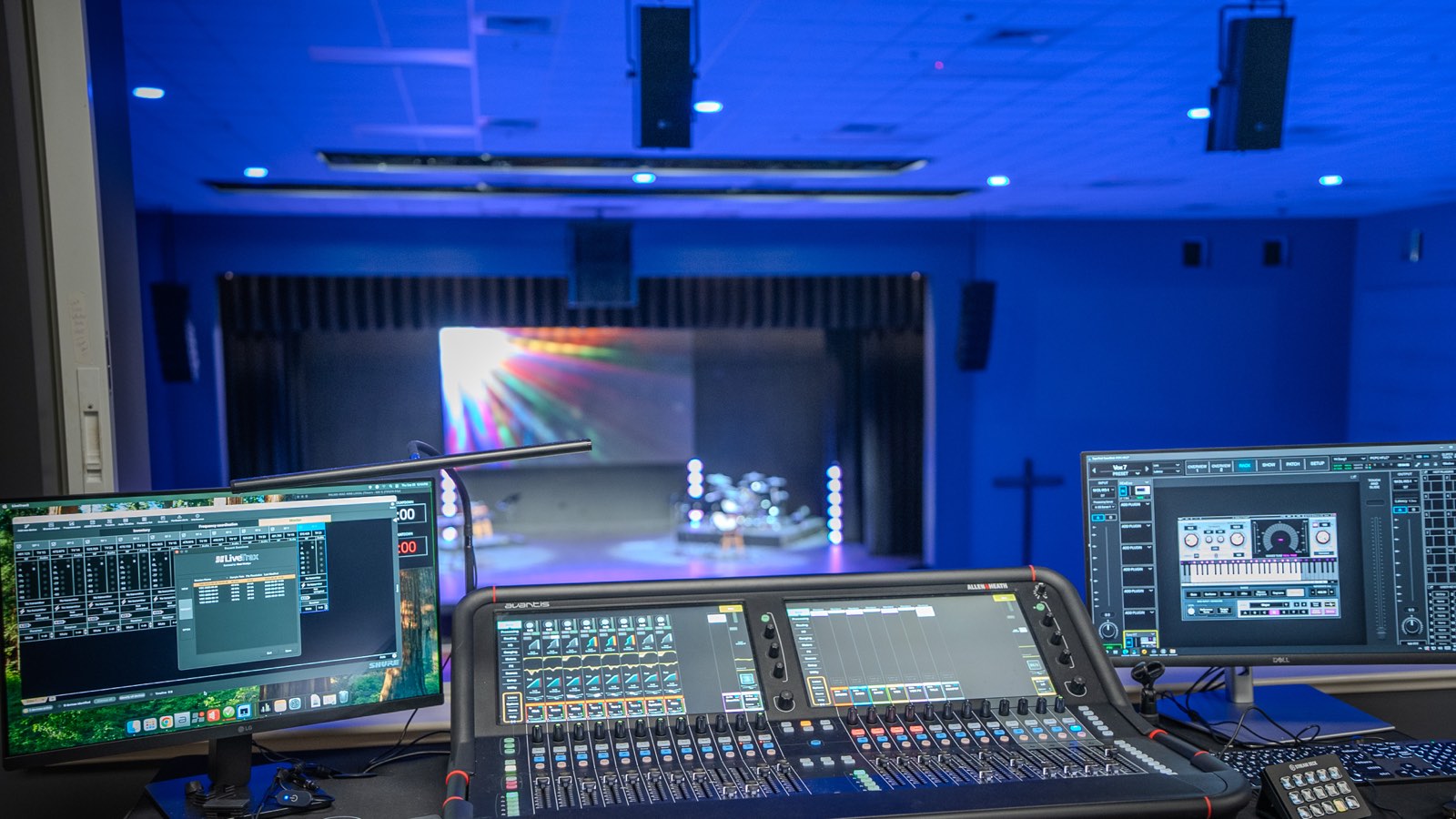
Allen & Heath is the console brand we specify on the large majority of our projects. It is reliable, well supported and easy for volunteers to learn, and its stage boxes, personal mixers and networking all work together.
Allen & Heath SQ series (SQ-5, SQ-6, SQ-7)
Our most frequently specified console. The SQ has a traditional, approachable layout, low-latency processing, and enough channels for most small and mid-size churches. It pairs with Allen & Heath stage boxes and ME personal mixers, and a Dante card connects it to recording and streaming.
Allen & Heath Avantis
Our choice for larger rooms, bigger bands and churches that run a separate broadcast or monitor mix. The Avantis offers 64 channels, large touchscreens and flexible I/O, with Dante and Waves options.
Allen & Heath Qu
A compact, affordable option for smaller churches, chapels and secondary rooms that still want scenes, a touchscreen and a path to digital stage boxes.
Allen & Heath dLive
For the largest churches and most complex services, where a dedicated monitor engineer, multiple mixes and extensive processing are the norm.
Other consoles worth knowing
We also specify other consoles when a church’s needs call for them. The Behringer Wing offers a lot of capability for its price and a flexible interface. The Waves LV1 suits churches that want Waves plugins at the center of their mix. The Yamaha DM7 brings Yamaha’s reliability and familiar workflow to churches that already know the brand. Each is a good console. We choose from the room, the team and the rest of the system.
Stage boxes, networking and processing
The console is the part people see, but the stage boxes and network behind it matter as much. On most Allen & Heath systems we use GX4816 or DX168 stage boxes, Dante cards for recording and streaming, and an AHM processor when a building needs zone mixing or automation. The result is less cable, cleaner signal and a system that can grow.
Setup and training matter more than the brand
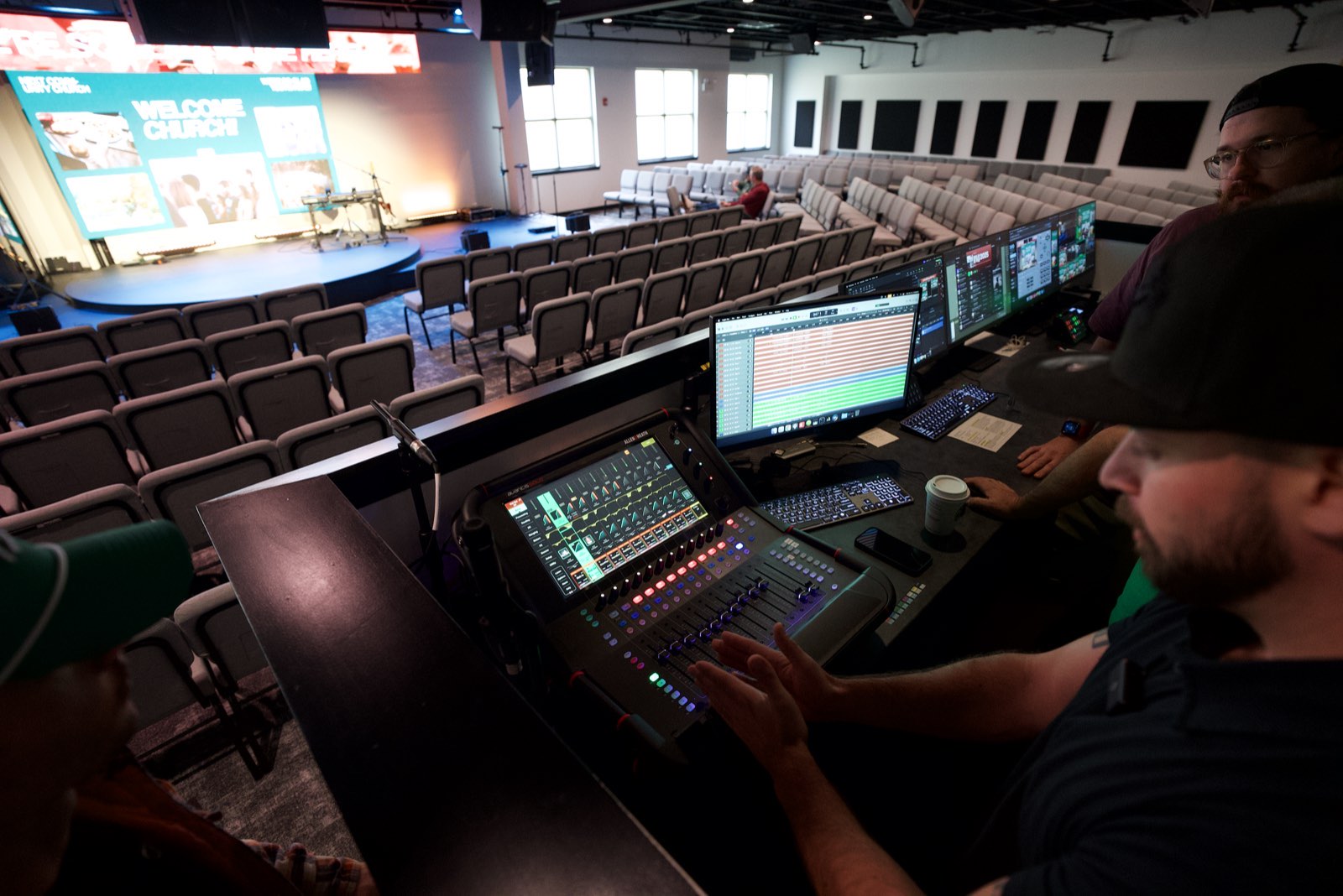
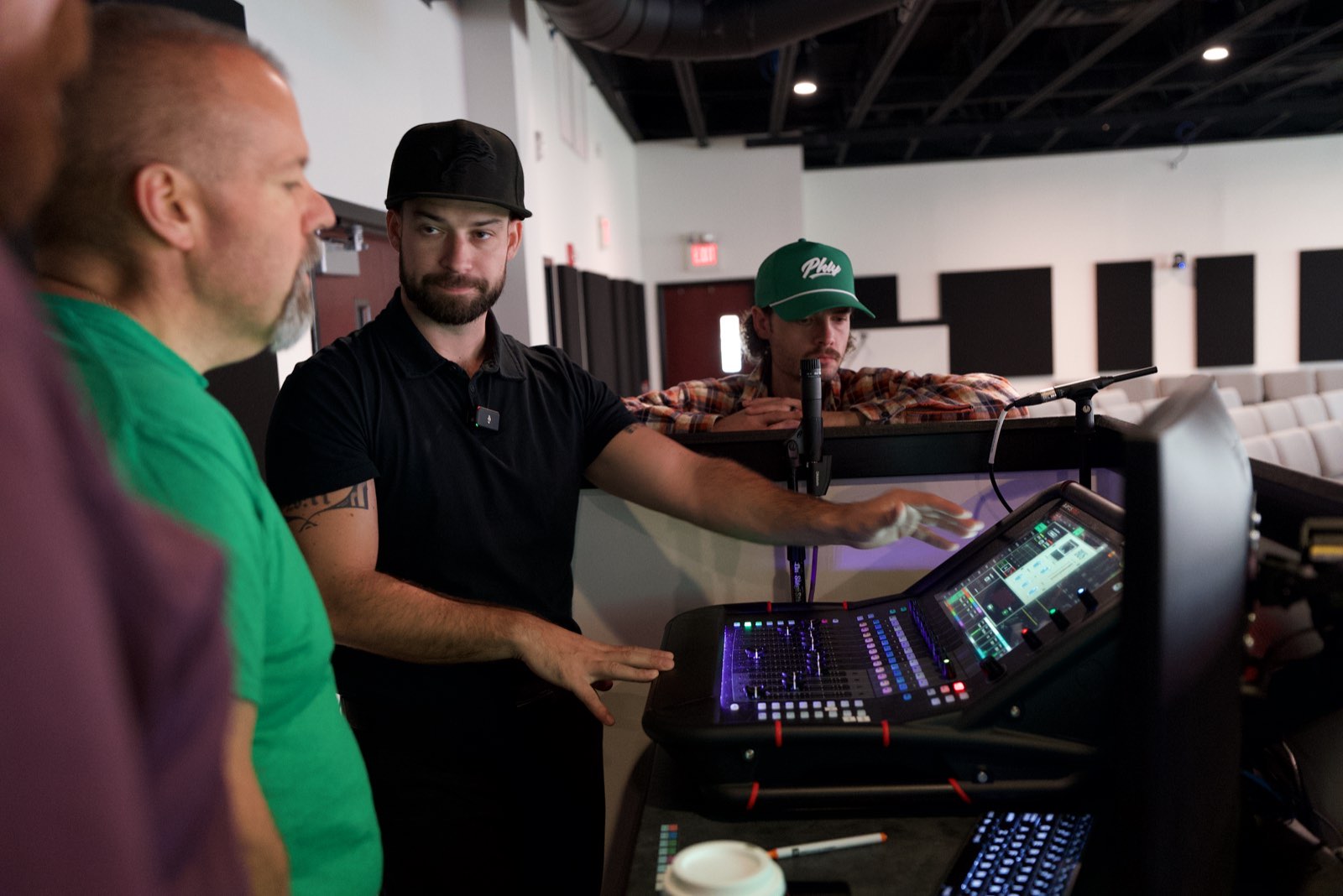
The most expensive console in the world will sound bad if it is set up poorly. Before handover, we build scenes for your services, lay out the channels the way your team thinks, set safes and permissions, and label everything. Then we train your volunteers on your console in your room.
A good console setup means a volunteer on a thin Sunday can walk in, recall the scene, and deliver a mix that sounds like the church’s best engineer set it up. That is what we mean by a console that works for your ministry.
Common questions
What is the best mixing console for a small church?
For most small churches, an Allen & Heath SQ-5 or a Qu-series console: enough channels to grow, scenes for repeatable mixes and an approachable layout. The best choice is the one your volunteers can learn and your team can support.
Allen & Heath SQ or Behringer Wing?
Both are capable. The SQ has a more traditional layout and a strong track record for reliability, which is why we specify it most often. The Wing offers a lot of features for its price and a more customizable interface.
How many channels does a church mixing console need?
Count every input you use today and add room to grow. Many small and mid-size churches are well served by 32 to 48 inputs, while larger bands and services may need 64 or more.
Do we need a digital stage box?
For most churches, yes. A stage box puts the inputs on stage and replaces a heavy analog snake with a single network cable, which makes installation cleaner and changes easier.
Should we upgrade our console or our speakers first?
It depends on where the problem is. If the room is muddy or coverage is uneven, the console will not fix it. Our guide to planning a church PA system explains the order we recommend.
Next steps
List every input and output you use on a typical Sunday, and write down who runs sound. Those two lists narrow the field quickly.
When you are ready for help, we design and install complete church sound systems, and we set up and train every console we deliver. See how we approach church sound system design and installation, or start with a pre-design visit.
You have where I can buy used mixer boards for a small church in Ghana with 32 channels?
My church currently is using a Peavey 32fx analog mixer and it has been working very well, but I have had to work on it several times lately. There is basically one volunteer to run the sound equipment and that is me. I am trying to find out if it would be worth switching to a digital mixer or stay with analog. We use a computer, CD player and wireless microphones. We have limited instruments used. I have no experience with a Digital Mixer, so it needs to be for beginners, but room for growth. Any suggestions would greatly be appreciated.