
The short answer: choose an LED wall if your room has daylight or a brightly lit stage, because projection washes out in both. Choose projection for a dark sanctuary, for side screens, or where the budget is better spent on sound and lighting. Many rooms are best served by both: LED at the center and projection at the sides.
Neither technology is the better one. Each fits a kind of room. This guide explains the differences that matter in a church and how to decide.
In this guide
- The real difference: light
- When LED is the right choice
- When projection is the right choice
- Using both
- Cost
- On camera
- What each asks of the building
- Common questions
- Next steps
The real difference: light
A projector throws light at a screen, and the screen reflects it to your eyes. Any other light that lands on the screen, from windows or from stage lighting, is reflected too, and the picture fades. An LED wall makes its own light. It stays vivid in a bright room.
That one difference decides most cases.
When LED is the right choice
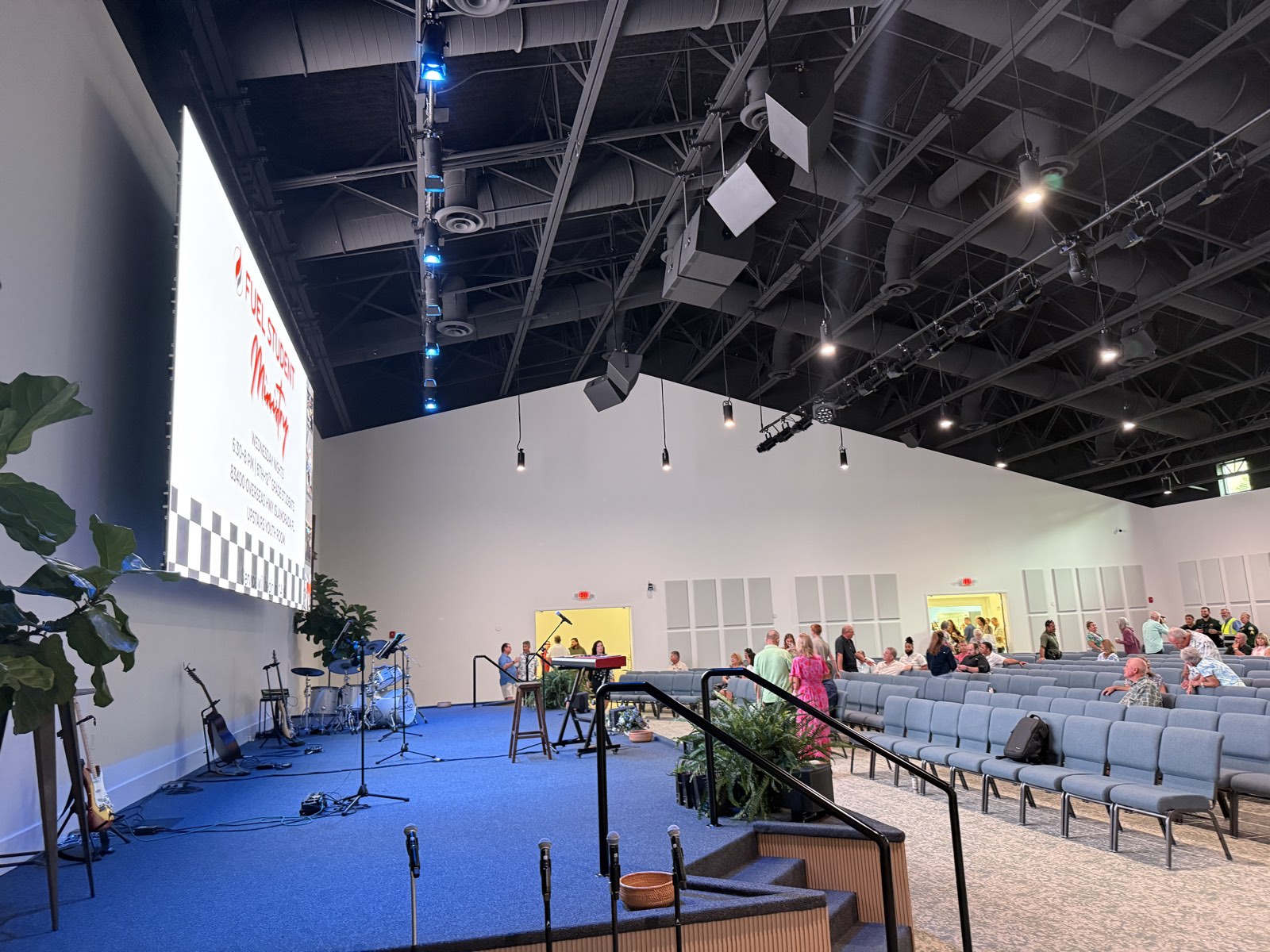
- The room has daylight. Windows near the platform wash out a projected image.
- The stage is well lit. Good front light on faces spills onto a projection screen. With LED, the lighting can do its job without fighting the screen.
- The screen sits behind the people on the platform. A center screen behind the band or pastor is where projection struggles most.
- You want a seamless backdrop, not a white rectangle when nothing is showing.
- There is no good projector position, or people would walk through the beam.
When projection is the right choice
- The sanctuary is dark or the light is controlled. In those rooms a projected image looks excellent.
- The screens are at the sides, away from stage lighting, mainly for lyrics and scripture.
- The budget is better spent elsewhere. If sound and lighting still need work, they come first.
- The screen has to disappear. A motorized screen can retract into the ceiling in a multipurpose room.
Modern laser projectors are bright and reliable, and they no longer need the lamp changes older projectors did.
Using both
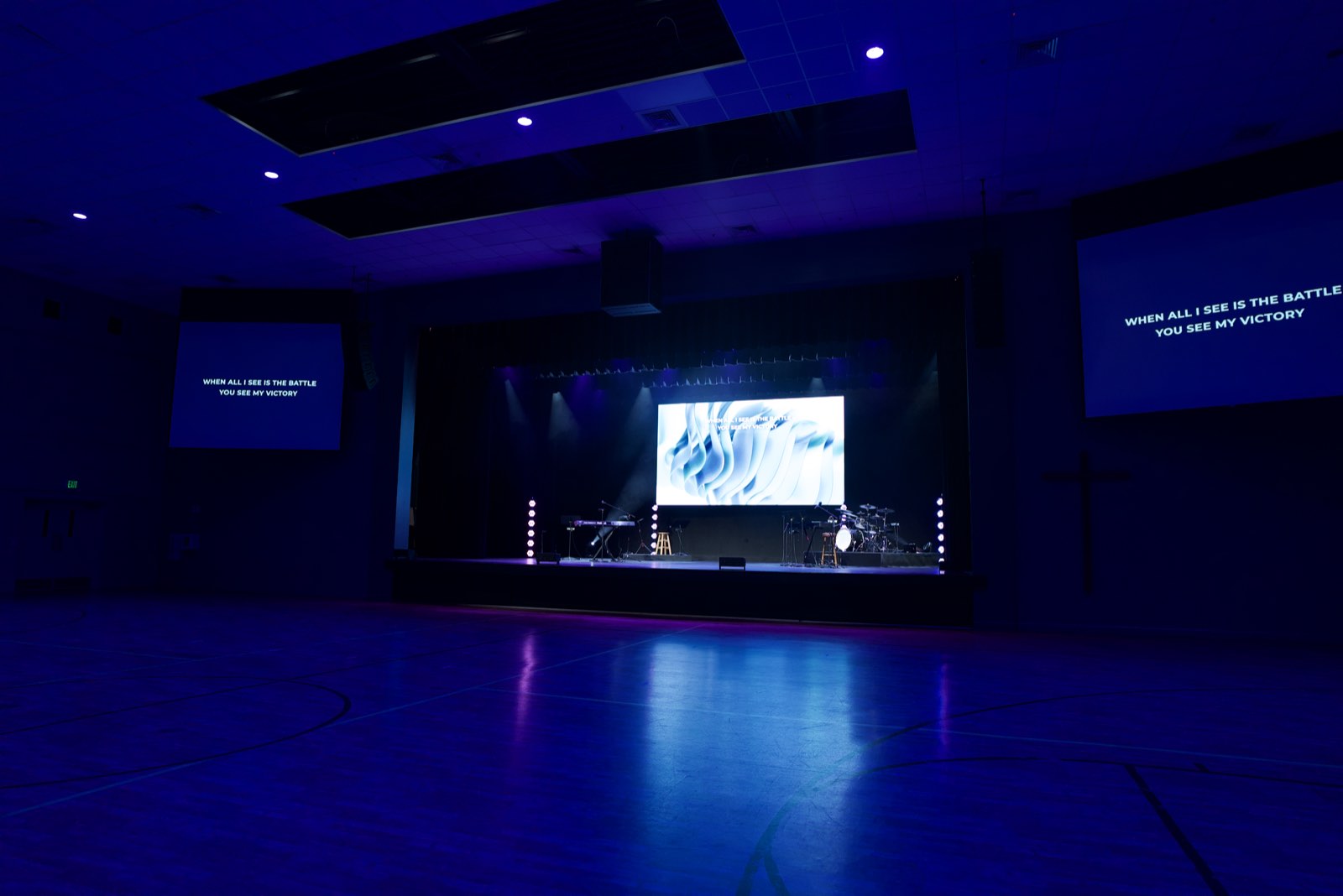
Many of our rooms use both. LED goes at the center of the platform, where light is strongest and where it appears on camera. Projection covers the side screens, where the light is lower and the content is simpler. Faith Covenant Church of God uses a center LED wall with laser projection on each side. It puts the more expensive technology only where it earns its cost.
Cost
For the same picture size, LED usually costs more. On our recent projects:
- Projection, including projectors, lenses and screens: about $5,000 to $27,000.
- An LED wall: about $27,000 to $44,000, and from roughly $13,000 to $90,000 depending on size and pixel pitch.
Both need installation, and LED also needs structure and more power. Our guide to what a church LED wall costs breaks the numbers down by size.
The comparison is not only purchase price. A screen nobody can read on a sunny morning is poor value at any price, and so is a wall with a finer pixel pitch than the seats need.
On camera
If you livestream, the screen behind the platform is in your shot. An LED wall holds its brightness on camera and can become part of the look of the stream. It has to be set up with the cameras: a wall that is too bright makes faces look dark, and the panel refresh rate has to suit the camera settings or lines and flicker appear.
A projection screen behind the platform usually looks washed out on camera, because the stage lighting the camera needs is the light that fades the screen.
What each asks of the building
- LED: structure to carry real weight, dedicated power, and a way to reach the panels for service. A flown or wall-mounted wall needs a structural review.
- Projection: a mounting position at the right distance with a clear path to the screen, and a screen surface. Lighter on structure and power.
Common questions
Is an LED wall better than a projector for a church?
In a room with daylight or a brightly lit stage, yes, because projection washes out. In a dark sanctuary or for side screens, projection is often the better choice and costs less.
Is an LED wall worth the extra cost?
It is when the room is bright, when the screen sits behind the platform, or when the screen appears on your livestream. If none of those apply, projection may serve you as well.
Can we use a projector in a room with windows?
You can, with a bright enough projector and some control of the light, but daylight on the screen will always reduce contrast. This is the situation where LED makes the biggest difference.
Do LED walls look bad on camera?
Not when they are set up with the cameras. Brightness has to be balanced with the stage lighting, and the refresh rate matched to the camera, before the panels are chosen.
Should side screens be LED or projection?
Projection is often enough for side screens, which mostly show lyrics and sit away from stage lighting. Many churches use LED at the center and projection at the sides.
Next steps
Stand at the back of your room on a bright Sunday morning and look at where a screen would go. How much light falls on that spot is the first thing an integrator will want to know.
For more on planning a wall, read our guide to church LED walls. When you are ready for help, see church LED wall design and installation, or start with a pre-design visit.